

What Is Despairalysis?
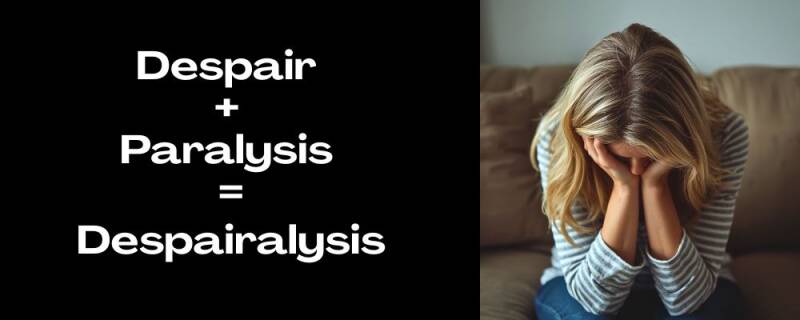
Despairalysis [noun] is a term coined by Maya Frost in 2020 to describe the state in which awareness of climate disruption, ecological decline, societal instability, or other systemic challenges becomes so emotionally overwhelming that it inhibits meaningful action.
Despairalysis: When Overwhelm Becomes Inaction
Many people today are carrying a heavy emotional burden. Climate change, ecological decline, political instability, economic uncertainty, war, social fragmentation, and the relentless stream of troubling news can leave us feeling overwhelmed by the state of the world.
We know something is wrong. We care deeply. We want to respond. Yet instead of taking action, we often find ourselves stuck.
What Is the Origin of the Term Despairalysis?
I coined the term despairalysis in 2020 during the COVID pandemic.
It refers to the combination of despair and paralysis that can arise when grief, fear, anger, hopelessness, and helplessness accumulate faster than our capacity to process them.
Despairalysis is the very human response to an overwhelming number of perceived threats, resulting in a protective withdrawal from addressing or even acknowledging the challenges.
I created the term despairalysis during my work with collapse-aware individuals who understood the realities of climate disruption, ecological decline, and social instability but felt increasingly unable to respond constructively. Existing terms such as climate anxiety, eco-grief, and overwhelm described pieces of the experience, but none captured the combination of awareness, emotional burden, and paralysis I was witnessing.
Despairalysis is not simply pessimism. It is not laziness. And it is not a lack of caring. In fact, the people most vulnerable to despairalysis are often the ones who care the most. They are thoughtful, informed, compassionate people who are paying attention to what is happening in the world.
The problem is not that they don't care. The problem is that they care so much that they become overwhelmed.
Rather than finding ways to acknowledge and process what is happening in order to respond in meaningful ways, we remain in a state of withdrawal from reality or failure to recognize the impacts of the changes we are facing.
The pandemic presented clear cases of systems collapse. From the failure to contain the virus by understanding how it spreads, to the financial and societal impacts (including shortages of goods, restricted income for businesses and individuals, increased isolation and anxiety), the collapse of systems created mass deaths, compromised healthcare delivery, and a long list of related failures with profound impacts around the world.
After the pandemic, the failures of our systems have continued to become more visible, from the rise of authoritarian leadship to the genocide in Gaza, the wars in Ukraine and Iran, as well as the breaching of tipping points indicating the growing risks of ecological, financial, and societal collapse.
And the entangled nature of our crises increases the complexity and uncertainty of the challenges we face, resulting in even higher levels of despairalysis.
What Despairalysis Looks Like
Despairalysis can take many forms.
For some people, it looks like doomscrolling. They consume more and more information, hoping that understanding the problem will somehow make it easier to respond. Instead, they become flooded with distressing information and feel increasingly powerless.
For others, it looks like avoidance. They stop reading the news. They change the subject. They focus exclusively on their personal lives. They tell themselves that things aren't really that bad or that someone else will figure it out.
Still others experience despairalysis as exhaustion, numbness, cynicism, procrastination, anxiety, or a persistent sense that nothing they do will matter.
The common thread is not the specific behavior. It is the feeling of being emotionally overwhelmed and unable to move forward.
Despairalysis vs Climate Anxiety
Climate anxiety and despairalysis are related, but they are not the same thing.
Many people experience climate anxiety without despairalysis, but despairalysis almost always includes some combination of anxiety, grief, uncertainty, and a diminished ability to imagine a meaningful future.
Climate anxiety describes the fear, worry, and distress people may experience in response to climate change and its anticipated impacts. While climate anxiety can be uncomfortable, it does not necessarily prevent meaningful action.
Despairalysis goes further. It describes a state in which awareness of climate change, ecological decline, social instability, or other systemic challenges becomes so overwhelming that it constrains imagination, diminishes agency, and inhibits engagement.
In other words, climate anxiety is an emotional response to a perceived climate-related threat, while despairalysis is the immobilization that can occur when grief, uncertainty, and concern accumulate to the point that a person struggles to envision possibilities or take constructive action.
Despairalysis vs Depression
Depression often affects a person's relationship with life itself, while despairalysis primarily affects their relationship with the future.
Depression is a recognized mental health condition that can affect mood, energy, sleep, concentration, and overall functioning across many areas of life.
Despairalysis, by contrast, is a response to the awareness of systemic challenges such as climate disruption, ecological decline, social instability, or the broader metacrisis. It occurs when grief, uncertainty, and concern become so overwhelming that a person struggles to imagine positive possibilities or engage constructively with the future.
While depression often narrows a person's sense of possibility regardless of context, despairalysis is specifically tied to the perceived realities of a changing world. Someone experiencing despairalysis may still find joy, connection, and purpose in many areas of life, yet feel stuck, overwhelmed, or unable to respond meaningfully to the challenges they see unfolding around them.
Despairalysis vs Burnout
Despairalysis and burnout can both leave people feeling exhausted, disengaged, and unable to take meaningful action, but they arise from different sources.
Burnout is often the result of carrying too much for too long. Despairalysis is often the result of seeing too much and no longer knowing what to do with what you see.
Burnout is typically the result of prolonged stress, excessive demands, or sustained overexertion without adequate rest, support, or recovery. It often develops in response to work, caregiving, activism, or other ongoing responsibilities.
Despairalysis, by contrast, stems from awareness of systemic challenges such as climate disruption, ecological decline, social instability, or the broader metacrisis. Rather than being depleted by doing too much, people experiencing despairalysis are often overwhelmed by what they see, know, or anticipate. The core challenge is not simply exhaustion but a diminished ability to imagine viable futures, identify meaningful responses, or translate concern into action.
While burnout may improve with rest, boundaries, and recovery, despairalysis often requires practices that restore agency, expand possibility thinking, and reconnect individuals with a sense of purpose and engagement.
Despairalysis vs Learned Helplessness
Learned helplessness is the belief that nothing you do will make a difference. Despairalysis is the inability to see what might be possible, even when you still care deeply and want to help.
Despairalysis and learned helplessness can both result in passivity, disengagement, and a reduced sense of agency, but they emerge through different pathways.
Learned helplessness is a psychological phenomenon that develops when repeated experiences of failure, powerlessness, or lack of control lead individuals to believe that their actions no longer matter. Over time, they may stop trying to change their circumstances, even when opportunities for influence exist.
Despairalysis, by contrast, arises from awareness of systemic challenges such as climate disruption, ecological decline, social instability, or the broader metacrisis.
People experiencing despairalysis are not necessarily responding to repeated personal failures. Instead, they may feel overwhelmed by the scale, complexity, and uncertainty of the challenges they perceive.
While learned helplessness is rooted in a belief that one's actions are ineffective, despairalysis often involves difficulty imagining meaningful possibilities, identifying appropriate responses, or translating concern into action.
Restoring agency in cases of despairalysis frequently requires expanding perceived possibilities, reconnecting with purpose, and developing new ways of engaging with an uncertain future.
The Freeze Response Nobody Talks About
When people think about stress responses, they often think about fight or flight. But there is another response that is equally important: freeze.
When our nervous system perceives a threat that feels too large, too complex, or too impossible to escape, it may shift into a freeze response. Rather than mobilizing us into action, it conserves energy by slowing us down, shutting us down, or disconnecting us from the situation.
This response evolved to help us survive overwhelming circumstances. In today's world, however, many of the threats we face are global and ongoing. Climate change cannot be outrun. Ecological decline cannot be solved in an afternoon. Political polarization cannot be fixed by reading one more article.
As a result, many people find themselves trapped in a prolonged state of overwhelm. Their nervous systems are responding exactly as they were designed to respond. The challenge is that the response itself can make meaningful action feel impossible.
Why Denial Can Be a Form of Self-Protection
One of the most misunderstood aspects of despairalysis is denial.
Many people assume that denial reflects ignorance or indifference. In reality, denial is often a protective mechanism. When a reality feels too painful, too frightening, or too destabilizing to fully absorb, our minds may create distance from it.
This doesn't necessarily mean rejecting reality outright. Denial can be subtle. It can look like minimizing problems, endlessly postponing difficult conversations, placing unrealistic faith in future solutions, or convincing ourselves that we don't need to think about something right now.
Denial often develops not because people don't care, but because they care deeply and don't yet have the emotional resources needed to engage with what they are seeing.
The Cost of Despairalysis
The tragedy of despairalysis is that it can create the very conditions that deepen despair.
When we feel powerless, we disengage. When we disengage, we lose our sense of agency. When we lose our sense of agency, we feel even more powerless.
Over time, this cycle can lead to isolation, loneliness, anxiety, burnout, and a diminished sense of meaning. We begin to feel like spectators watching events unfold rather than participants in shaping what comes next.
But small acts of engagement can begin rebuilding our sense of agency. Meaningful action, however modest, reminds us that we are not powerless.
The Despairalysis Cycle and How To Disrupt It
While despairalysis can show up in a variety of ways, it tends to follow a predictable cycle.
Awareness → Overwhelm → Freeze → Withdrawal → Reduced Agency → Greater Despair
We can disrupt the despairalysis cycle by changing the habitual responses that become locked in during the key stages.
Collapse Companioning™ is the process I created to do just that.
Based on recent research in human behavior and habit change, primarily the findings of Dr. Judson Brewer and Dr. BJ Fogg, Collapse Companioning™ applies a habit-replacement model featuring daily prompts and reflection that naturally create consistency and momentum over the course of 30 days.
By recognizing the generalized anxiety responses tied to despairalysis as a habit rather than a condition, and addressing it through proven behavior-change techniques, clients can experience a dramatic reduction in their sense of despair and a clear increase in their ability to take meaningful action in ways that uplift and energize them.
Rewilding Imagination: The Key to Disrupting Despairalysis
One of the most powerful antidotes to despairalysis is a process I call rewilding imagination.
When people become overwhelmed by uncertainty, grief, and awareness of systemic challenges, their sense of what is possible often begins to shrink.
Rewilding imagination is the process of restoring the ability to envision alternatives, explore possibilities, and imagine meaningful futures beyond the dominant narratives of decline and limitation.
Rather than denying reality, it expands our capacity to engage with it creatively. By cultivating curiosity, possibility thinking, and future visioning, rewilding imagination can help transform overwhelm into agency and open new pathways for adaptive engagement.
Moving Beyond Despairalysis
The way out of despairalysis is not through forced positivity. It is not through pretending everything will be fine. And it is not through consuming more information.
The first step is often recognizing that despairalysis is happening. Naming the experience can reduce its power. It helps us understand that what we are feeling is not a personal failure but a natural response to difficult realities.
From there, the goal is not to solve every problem. It is to reconnect with agency.
Meaningful action does not eliminate grief, fear, or uncertainty. But it changes our relationship to them.
From Despair to Participation
The opposite of despairalysis is not certainty.
The opposite of despairalysis is participation.
It is the willingness to remain engaged with life even when outcomes are unclear. It is choosing connection over isolation, contribution over resignation, and action over helplessness.
We do not need to save the world single-handedly. We do not need perfect answers before we begin. We simply need to take the next meaningful step.
Despairalysis tells us that nothing we do matters.
Getting more engaged in life has a way of proving otherwise.
How to Move Beyond Despairalysis
When we feel overwhelmed by problems that seem too large to solve, it's easy to lose sight of our ability to influence anything at all. Yet agency is often restored not through grand gestures, but through small, meaningful acts that reconnect us to ourselves, other people, and the world around us.
Action reminds us that we are participants in life, not merely observers.
Participation can take many forms. The specific action matters less than the shift it creates.
Each act of participation strengthens our sense of agency, builds resilience, and reminds us that even in uncertain times, we still have choices about how we show up and what we contribute.
Here are a few suggestions:
- Learn a practical skill.
- Grow something.
- Repair something.
- Create something.
- Teach something.
- Join a community group.
- Support a local initiative.
- Volunteer your time.
- Participate in mutual aid.
- Reduce one dependency on a fragile system.
- Strengthen a friendship.
- Meet your neighbors.
- Spend time in nature.
- Make art.
- Share a meal.
- Have a difficult but meaningful conversation.
- Contribute to a project larger than yourself.
None of these actions will solve the metacrisis. That's not their purpose.
Their purpose is to restore agency, strengthen connection, and remind us that even in times of uncertainty, we can still participate in shaping the future.
Turn Your Despairalysis Into Rewilded Imagination and Inspired Action
If you´re struggling with despairalysis, you don't have to navigate it alone.
Much of my work is devoted to helping people move from feeling overwhelmed toward greater clarity, agency, and possibility.
For some, that begins with a Visioning Series, a week-long process designed to help you reimagine what is possible in your life, work, relationships, and future. (Through August 2026, the Visioning Series is available at half price for those under the age of 30.) It is ideal for those who are putting off a major decision, experiencing a creative block, or starting a new project.
For those seeking a more all-encompassing transformation with deeper support, the 30-Day Private Collapse Companioning Experience offers a month of dedicated guidance through daily conversation, reflection, and insight. Together, we explore the realities you're facing, make space for the emotions that arise, and uncover pathways forward that are aligned with your values, strengths, and hopes for the future.
The goal isn't to eliminate uncertainty. (Uncertainty is basically the air we breathe now.)
It's to help you meet it with greater resilience, meaning, and a renewed sense of agency.
Let´s Walk Through This Together
As a skilled, experienced, and compassionate Collapse Companion and the creator of Lucid Longing, I love helping those who are struggling turn their despairalysis into creative energy and inspired action.
If you are looking for support that is specifically designed to disrupt despairalysis through daily connection, I would be honored to work with you.

It all starts with a simple form where you can tell me about yourself.