

Maya Frost's Proven Process For Transforming Climate Anxiety and Collapse Grief Into Creative Energy and Adaptive Engagement
The Research-Based Process That Can Dramatically Reduce Anxiety and Increase Creativity and Connection in 30 Days
Maya Frost helps collapse-aware individuals transform grief, outrage, burnout, and uncertainty into creative adaptation, emotional resilience, and meaningful action through her process called Collapse Companioning™.
People Come To Her To:
- process climate anxiety
- recover from burnout
- rediscover their creativity
- build emotional resilience
- navigate major life transitions
- reconnect meaningingfully with community
In early 2020, just as the pandemic started, Maya Frost (a mindfulness trainer and certified creative breakthrough coach with an extensive personal history of overcoming grief) began using a 30-day private companioning process to help individuals (mostly women, ages 35-65) who were facing devastating levels of grief and anxiety. Due to the severity of these cases, Ms. Frost offered support at no charge to those who were referred to her by contacts working in non-profit organizations.
These women were experiencing crushing levels of despair that made it difficult to get out of bed or functionally perform the most basic tasks, including taking a shower, getting dressed, or eating a meal. They were at high risk of self-harm or suicide.
Within 30 days, all of her clients were not only capable of daily tasks, but they had transformed their perspective and their habits, creating a project that healed them as they helped others.
🔶 The Challenge: Our Current Therapy and Coaching Offerings Are Not Designed To Meet The Needs Of Those Experiencing Reality-Based Climate Anxiety, Collapse Grief, or Existential Dread
Most people are seeing our systems fail and our crises collide.
They are experiencing an unprecedented onslaught of news and updates that constantly trigger a combination of emotions, including grief, anger, fear, guilt, shame, helplessness, and hopelessness.
Not only are they overwhelmed, but many are turning to traditional models of psychotherapy and coaching to address their rapidly increasing levels of anxiety and despair.
Under these extraordinary circumstances, it is misguided to expect the traditional schedule of one hour-long session per week to effectively serve distressed individuals in the following areas:
🔸staying steady emotionally despite inadvertent or intentional exposure to negative news
🔸processing the reality of the ecological, societal, economic, and political shifts with any degree of depth or complexity
🔸creating a practical and meaningful way to live fully daily with this knowledge
🔸taking action to adapt and thrive in ways that require new and relevant skills that are not yet clearly defined or understood
And it's especially unfortunate when there are tested and proven alternatives that are specific, effective, and work quickly to reduce self-reported levels of grief, anxiety, anger, and hopelessness.
🔶 Maya Frost's Unique 30-Day Collapse Companioning™ Process For Dramatically Reducing Self-Reported Levels of Grief and Anxiety Related To Climate and Systems Collapse
Since developing her process while serving those who were struggling with grief and anxiety during the pandemic, Ms. Frost has been helping individuals who have been directly impacted by collapse, both personally and professionally.
Their challenges include systemic failures such as war, school shootings, environmental hazards, political antagonism, and the loss of homes due to increasing storms, floods, and wildfires.
In addition, she serves clients anticipating changes that require awareness of possible futures and a realignment in purpose and planning. These major shifts will impact businesses, organizations, and governments, as well as individual choices regarding lifestyle, location, education, and future planning.
Using the same 30-day private companioning process with leaders at all levels, she has been able to help her clients transform their grief and anxiety into curiosity, creative energy, and inspired action that leads to deeper awareness in those they serve and a collective effort to make critical adaptations.
This process is not coaching. Despite her own training as a creative breakthrough coach, Ms. Frost's process does not follow traditional coaching protocols. However, creative breakthrough techniques are useful in guiding clients through creative blocks that often accompany grief and anxiety.
It is not mindfulness. Though Ms. Frost has extensive training and experience in this area (she created a playful mindfulness course in 2003 that helped thousands of people in over 100 countries reduce stress, increase clarity, and enhance creativity), she does not use traditional mindfulness techniques. Instead, she focuses on expanding capacity for curiosity and imagination.
It does not follow the typical once-a-week schedule. Her first clients were facing devastating losses and, in some cases, extended quarantines that prevented them from grieving with others or even saying goodbye to their loved ones before they died. Because of their imposed isolation, these clients required more immediate and frequent support. The once-a-week model would have put them at serious risk of self-harm or suicide.
Her choice to offer daily support was a radical departure from other helping professions and based on research about habits and behavior change. It has led to positive self-reported benefits for her clients.
🔶The Collapse Companioning™ Process Is Grounded In Recent Research On Anxiety, Habits, and Human Behavior Change
Frost 's process, requiring daily connection over a period of 30 days, has been proven effective in creating consistency, momentum, and lasting change.
It is influenced by the research of Brown University neuroscientist and psychotherapist Dr. Judson Brewer and others who have shown that generalized anxiety (what many people are experiencing in this time of uncertainty) is actually a habit, not a condition. Like most habits, it can be changed, with anxiety dramatically reduced in 30 days using techniques focused on curiosity and awareness.
It is also inspired by the work of Dr. BJ Fogg, professor of human behavior at Stanford University and the author of Tiny Habits, describing the most effective ways to change our behavior by focusing on small shifts in our habits.
🔶Additional Sources of Inspiration for Maya Frost's Development Of Her 30-Day Collapse Companioning™ Process
In addition to the research that inspired Ms. Frost, her own personal experiences significantly impacted her creation of this process.
Adopted at birth, her parents then divorced when she was four, and she moved with her mother and her two younger brothers to live with her grandparents in Oregon. Shortly thereafter, her grandfather died suddenly while mowing the lawn, catapulting the already-reeling family into deep grief and a struggle to survive.
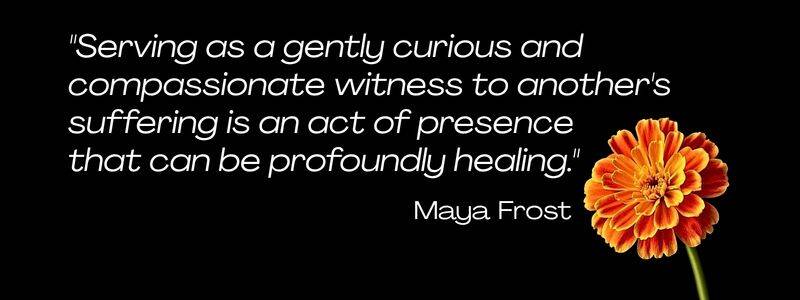
Ms. Frost found comfort in the backyard garden, where she transplanted her first marigold seedlings. As she tended them lovingly, her grandmother explained to her that marigolds were "plants that protect other plants just by being there."
This idea of protective presence sparked a sense of magical thinking for Ms. Frost that ultimately planted the seed of her work in companioning those who were lost and grieving. She uses the marigold as the symbol for her company and inspiration for others who long to protect what is around them.
Years later, as she struggled with her grief and survivor guilt after an accident that killed four teens but left her uninjured, she created a simple mindfulness game that soothed and inspired her. Then, in her 40s, as she was processing the deaths of two brothers to suicide and one of AIDS, she turned that game into an online mindfulness course that inspired thousands of subscribers around the world with her playful, eyes-wide-open approach to everyday awareness.
🔶 Focus on Emotional Steadiness, Clarity About Behaviors, New Habits That Expand Curiosity and Creativity, and Inspired Action That Enhances Healing
Collapse Companioning™ is designed to assist clients as they:
▲develop their ability to assess their emotional state and regulate their nervous system
▲gain clarity about the habits and behaviors that are reinforcing anxiety
▲create new habits and behaviors that expand their capacity for curiosity, awe, gratitude, and deepened relationships
▲metabolize their grief and enhance their healing by helping others
According to Ms. Frost, coming to terms with our crises is both a personal and a relational challenge. It requires us to address our own emotions and habits, and then connect with others in caring and collaborative ways.
Individuals experiencing grief and anxiety related to current realities require a practitioner who offers deep listening, provides prompts and provocations for reflection, and serves as a co-creative partner.
As clients tap into their longing and define for themselves how they will choose to protect the people, places, and possibilities that matter to them, they experience a renewed sense of agency, creative energy, and purpose. This, in turn, leads to inspired action, satisfying engagement, and a deeper appreciation for collaboration and community.
It is this new level of connection that leads to greater resilience through meaningful relationships and mutual aid.
🔶The Results of the 30-Day Collapse Companioning™ Process
Ms. Frost has found the most effective way to offer private companioning to clients around the world is through continuous daily but asynchronous support via video chats, voice notes, and texts.
The key to the rapid progress of her clients seems to be related to both the consistency and the time lapse between Ms. Frost's daily question or prompt and the client's response. Rather than responding in real time, the interim space, even as short as a few minutes, significantly increases the likelihood of deeper insights on a daily basis, leading to a consistent flow of processing, inspiration, and energy that builds momentum naturally.
In addition, these insights compound in ways that deepen the client's understanding of their own thoughts and behaviors (metacognition), resulting in what clients describe as more grounded and confident decision-making and expanded capacity for creativity.
🔶 Maya Frost's Professional Bio
Maya Frost, founder of Collapse Forward, is the creator of Collapse Companioning™, her deep process of curious and compassionate presencing that transforms climate anxiety and collapse grief into creative energy and rewilded imagination. Since 2020, she has held space for hundreds of individuals at their breaking-open points: devastating loss and grief, searing identity shifts, and existential awakening. Her signature 30-day process has helped clients in over 20 countries turn despair into depth, discovery, daring, doing, and delight despite everything.
In the early 2000s, her playful, eyes-wide-open approach to everyday mindfulness sparked the imagination of people in over 100 countries, and was featured in 150 media outlets around the world. Her focus on awe and awareness was inspired by her own struggle to overcome her grief as the sole survivor of a tragic car accident at the age of 15.
At international polycrisis-focused conferences (including the 2026 World Adaptation Forum in Budapest) and collective sense-making events (such as Integra in Amsterdam), she serves as a keynote speaker offering stories of our surprising capacity to creatively reclaim our agency and protect the people, places, and possibilities we love.

Maya Frost, founder of Collapse Forward, is a U.S. citizen living in Amsterdam, The Netherlands. She grew up in a garage in a tiny rural town in Oregon, and is a mother, grandmother, and elder who has lived in seven countries. Her roles have ranged from educator (including vice principal) and artist (her work has been shown in four countries) to entrepreneur and non-profit leader.
She started studying Buddhism in 1975, is the author of The New Global Student (Crown/Random House 2009), and has served as the private English tutor for the family of Jack Ma, founder of Alibaba, in China.
Visit MayaFrost.com to read her story and sign up for her Collapse Companion newsletter.
Email her at maya@mayafrost.com
Connect with her on LinkedIn at https://LinkedIn.com/in/mayafrost